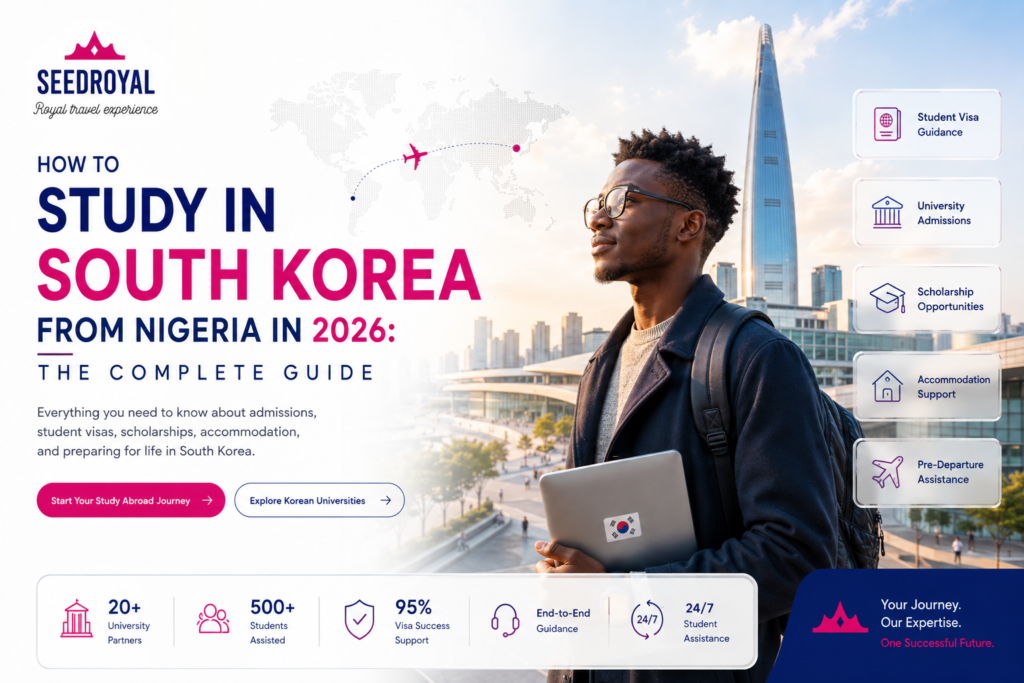
Are you a Nigerian student considering studying in South Korea? You are making an excellent choice. South Korea has rapidly become one of the world’s most exciting study abroad destinations — combining world-class universities, cutting-edge technology, affordable tuition fees, generous scholarships and one of the most vibrant youth cultures on the planet.
Seoul was recently named the top student city in the world and the South Korean government is actively welcoming more international students. This complete guide on how to study in South Korea from Nigeria in 2026 gives you everything you need to know — from choosing the right university and applying for a student visa to scholarships, living costs and life in Korea.
Why Study in South Korea from Nigeria?
World-Class Universities
South Korea is home to some of the world’s top-ranked universities such as Seoul National University, Korea University and Yonsei University — known as the SKY Universities. These institutions are renowned for their academic excellence, cutting-edge research and innovative programs. A South Korean degree is recognised and respected worldwide.
Affordable Tuition Fees
Tuition fees in South Korea are significantly more affordable than the UK, USA or Australia — making it an excellent value study destination for Nigerian students. Contact SeedRoyal Travels for current tuition fee estimates for your chosen university and programme.
Generous Scholarships
South Korea offers some of the most generous scholarships available to Nigerian students:
GKS — Global Korea Scholarship (Most Prestigious) This prestigious scholarship covers tuition, airfare, a monthly stipend and other expenses for undergraduate and graduate students. The GKS scholarship is fully funded and one of the best opportunities available to Nigerian students worldwide.
University Scholarships Many South Korean universities offer scholarships for international students based on merit or need. Examples include the Seoul National University Scholarship and Yonsei University’s Global Leader Program. Organizations like the Korea Foundation and private companies also provide funding opportunities for international students.
Post-Study Work Opportunities
South Korea offers excellent post-study work opportunities for international graduates. With Korea’s booming technology, manufacturing, entertainment and finance sectors there are strong career opportunities for qualified Nigerian graduates.
Korean Culture and Lifestyle
K-Pop, K-Drama, Korean food and Korean fashion have a massive global following including in Nigeria. Studying in South Korea gives you direct access to the culture that millions of Nigerians already love — an extraordinary and immersive experience.
Top Universities in South Korea for Nigerian Students
Seoul National University (SNU)
South Korea’s most prestigious university consistently ranked among Asia’s top 10 universities. Located in the capital Seoul, SNU offers programmes across all major disciplines at undergraduate and postgraduate level.
Korea University
One of South Korea’s most respected universities offering a wide range of programmes in English. Located in Seoul with a strong international student community and excellent scholarship opportunities.
Yonsei University
Part of the prestigious SKY trio, Yonsei University is one of South Korea’s oldest and most respected universities. Strong in business, medicine, engineering and humanities.
KAIST — Korea Advanced Institute of Science and Technology
South Korea’s leading science and technology university. One of the best universities in Asia for engineering, computer science and technology programmes. Excellent scholarship opportunities for international students.
Sungkyunkwan University (SKKU)
A highly respected university partly funded by Samsung. Strong in business, engineering and humanities with excellent industry connections.
Konkuk University
Konkuk University offers scholarships tied to TOPIK exam results making it an excellent option for Nigerian students who invest in learning the Korean language.
Types of South Korea Student Visas
D-2 Visa — Academic Degree Visa (Most Common)
The D-2 visa is for academic degrees — bachelor’s, master’s and PhD programmes. This is the visa most Nigerian students will need to study at a South Korean university. In 2026 the process requires strict and clear documentation to ensure a successful application.
D-4 Visa — Korean Language Training Visa
The D-4-1 visa is for Korean language training. If you want to learn Korean before starting your degree programme this is the visa you need. You can later convert a D-4 visa to a D-2 visa after completing your language training.
How to Study in South Korea from Nigeria — Step by Step
Step 1 — Choose Your University and Programme
Research South Korean universities and identify programmes that match your qualifications and career goals. Most top South Korean universities offer programmes taught in English so Korean language proficiency is not always required — though it is a significant advantage.
Key things to consider:
- Does the university offer your chosen programme in English?
- What are the entry requirements and minimum grades?
- Does the university offer scholarships for Nigerian students?
- What is the university’s ranking and reputation in your field?
Step 2 — Apply for the GKS Scholarship First
If you are applying for the Global Korea Scholarship (fully funded) apply for the scholarship first as deadlines are typically in February and March each year. GKS scholarship recipients receive their university placement as part of the scholarship process.
Step 3 — Apply to Your Chosen University
Apply for fall intake during March to May and for spring intake during September to November. Most South Korean universities accept online applications through their international student portals.
Required application documents typically include:
- Completed application form
- Academic transcripts and certificates (WAEC, NECO, university degrees)
- Personal statement or statement of purpose
- Letters of recommendation
- English language proficiency proof (IELTS or TOEFL) for English-taught programmes
- TOPIK (Test of Proficiency in Korean) results for Korean-taught programmes
- Valid Nigerian passport copy
- Passport photographs
Step 4 — Apply for Your Student Visa (D-2)
After receiving your Certificate of Admission from a South Korean university apply for your D-2 student visa at the Embassy of the Republic of Korea in Abuja.
Apply for your visa as soon as you receive your Certificate of Admission. Processing times can vary and delays are more common during peak seasons — January to February for March intake and July to August for September intake.
Documents required for South Korea D-2 student visa:
- Completed visa application form with passport-sized colour photograph (3.5cm x 4.5cm)
- Valid Nigerian passport with minimum 6 months validity
- Certificate of Admission from your South Korean university
- Academic transcripts and certificates — apostilled
- Proof of sufficient financial capacity — bank statements
- Proof of scholarship (if applicable)
- Medical certificate from approved physician
- Police clearance certificate
You need to demonstrate proof of sufficient funds to support yourself during your studies. Contact SeedRoyal Travels for the current financial requirements applicable to your situation.
Step 5 — Get Your Alien Registration Card (ARC) on Arrival
After arriving in South Korea you must register and obtain your Alien Registration Card (ARC) — a personal identification card for foreigners allowing you to stay in Korea legally. Register within 90 days of arrival at your local immigration office.
Living Costs in South Korea for Nigerian Students
Living costs in South Korea are reasonable compared to other major study destinations. Monthly expenses covering accommodation, food, transport and personal expenses are generally lower than the UK, USA or Australia. Health insurance is mandatory for all international students in South Korea — contact SeedRoyal Travels for current cost estimates.
University dormitories are the most affordable accommodation option and are available at most South Korean universities for international students. Shared apartments near campus are also a popular and affordable option.
Can Nigerian Students Work While Studying in South Korea?
Yes. International students in South Korea on a D-2 visa are permitted to work part-time during their studies subject to restrictions. You must obtain a part-time work permit from the immigration office after arrival. The number of permitted working hours varies based on your academic progress and year of study.
Korean Language — Do You Need to Learn Korean?
For programmes taught in English Korean language proficiency is not mandatory for admission. However learning Korean significantly improves your university experience, career prospects in Korea and daily life. Many South Korean universities offer free or subsidised Korean language classes for international students.
The TOPIK (Test of Proficiency in Korean) is the official Korean language proficiency test. Higher TOPIK scores can also unlock additional scholarship opportunities at many universities.
How SeedRoyal Travels Can Help You Study in South Korea
At SeedRoyal Travels and Tours we offer comprehensive study abroad packages for Nigerian students planning to study in South Korea. Our services include:
- Free initial study abroad consultation
- University and programme shortlisting based on your qualifications and budget
- GKS scholarship application guidance
- Application form completion and submission guidance
- D-2 student visa application and document preparation
- Apostille and document authentication guidance
- Flight booking from Lagos to Seoul
- Airport transfer arrangements on arrival in South Korea
- Student accommodation recommendations
- Travel insurance for students
- Pre-departure orientation
Visit our Study Abroad Packages page for full details.
Frequently Asked Questions
Do I need to know Korean to study in South Korea? Not necessarily. Many top South Korean universities offer degree programmes taught entirely in English. However learning Korean enhances your experience significantly and opens up more opportunities.
What is the GKS scholarship and how do I apply? The Global Korea Scholarship (GKS) is South Korea’s prestigious fully-funded government scholarship covering tuition, airfare, monthly stipend and living allowance. Applications open annually — typically February to March. Contact SeedRoyal Travels for guidance on applying.
Is a South Korean degree recognised internationally? Yes. Degrees from top South Korean universities are recognised and respected worldwide. SKY universities (Seoul National, Korea and Yonsei) are ranked among the world’s best.
How long does a South Korea student visa take to process? Processing times vary but typically take 2 to 4 weeks. Apply as early as possible after receiving your Certificate of Admission.
Can I bring my family to South Korea while studying? Dependent family members can apply to accompany you to South Korea on a dependent visa. Contact SeedRoyal Travels for guidance on family visa arrangements.
What is the academic year in South Korea? The academic year runs from March to February. Application windows are set by individual universities. Most universities have two intakes — spring (March) and fall (September).
Ready to Study in South Korea?
Contact SeedRoyal Travels and Tours today and let our study abroad experts guide you through every step of your South Korea journey!
Also read our other study and travel guides:
📞 Call/WhatsApp: +234 707 834 3271 or +234 703 108 6234
📧 Email: info@seedroyaltravels.com
🌐 Website: seedroyaltravels.com
🏢 Office: Suite E412, Ogba Central Mall, 4th Floor, Ogba, Lagos